
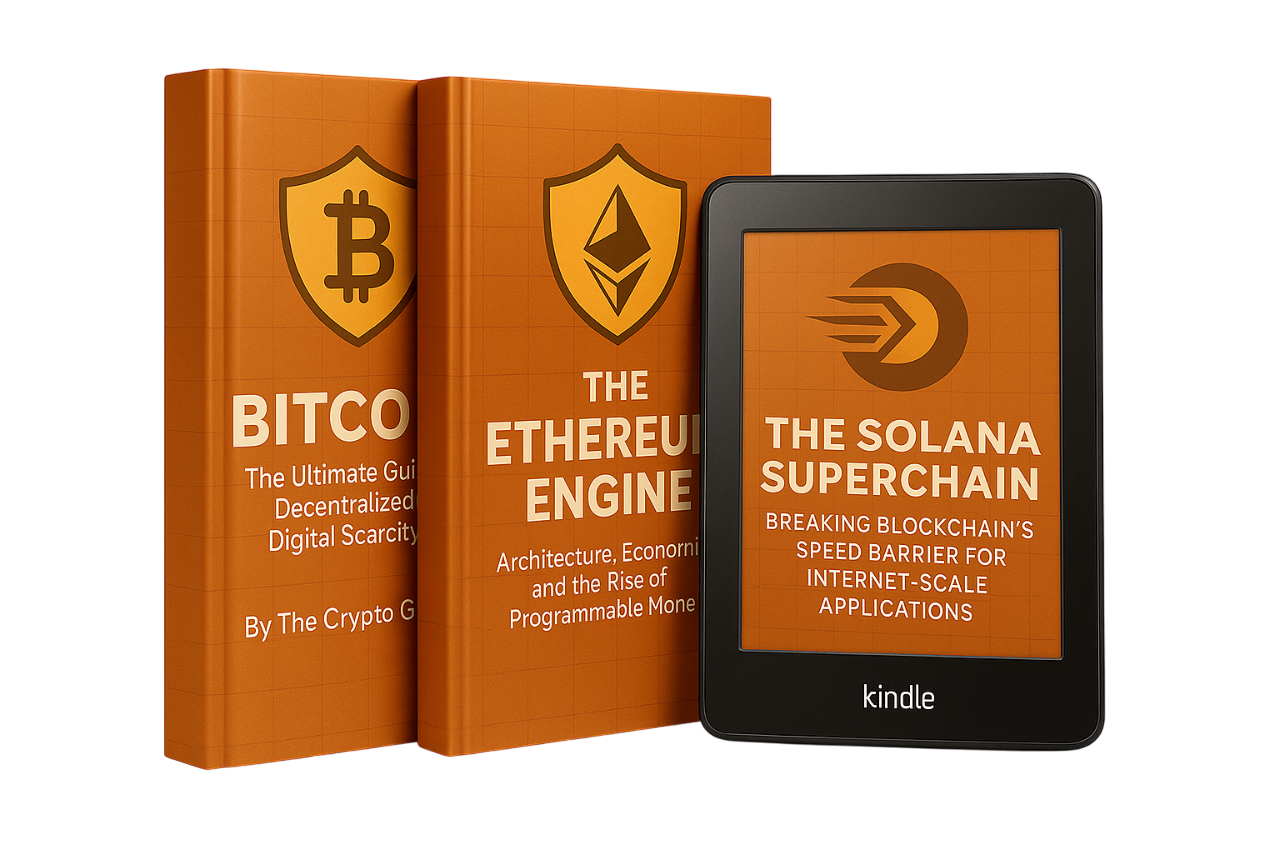
Blockchain’s Big Three: The Complete Guide”
Stop guessing about Bitcoin, Ethereum, and Solana. This comprehensive 423-page bundle delivers 67 research-backed chapters covering architecture, economics, documented failures, and institutional adoption patterns across the entire industry landscape. Learn why 848,000 BTC sit in corporate treasuries, how Ethereum’s Merge cut energy 99.99%, what Solana’s 96% FTX crash revealed about resilience. Bitcoin: 162 pages, 22 chapters. Ethereum: 114 pages, 23 chapters. Solana: 147 pages, 22 chapters. Built for investors, developers, compliance teams. 423 pages. 67 chapters. Zero hype. Complete clarity.
Original price was: $79.00.$39.00Current price is: $39.00.
Look, we get it. You’re tired of blockchain content that either worships decentralization or dismisses everything as a scam. You want to understand Bitcoin, Ethereum, and Solana without tribal cheerleading or dismissive cynicism. You want specific numbers, documented failures, honest risk assessment, and zero ideology. That’s exactly what this 423-page collection delivers across 67 meticulously researched chapters.
What you’re getting is brutally comprehensive. This bundle combines three standalone guides covering Bitcoin (162 pages, 22 chapters), Ethereum (114 pages, 23 chapters), and Solana (147 pages, 22 chapters). Each guide dissects its blockchain from first principles through institutional adoption, covering architecture, economics, governance, security incidents, regulatory status, and real-world usage.
The Bitcoin section walks through the 21 million cap, explains why 2.3 to 4 million BTC are permanently lost, and documents how public companies now hold 848,000 BTC led by MicroStrategy and Tesla. The Ethereum guide confronts the 2016 DAO hack that drained 3.6 million ETH worth $70 million, explains the September 2022 Merge that cut energy use by 99.99% to 0.0026 TWh annually, and maps $24 billion in real-world assets across 100-plus major DeFi protocols. The Solana analysis examines the 96% price collapse after FTX, documents multiple outages in 2021 and 2022, and tracks current performance hitting 400 to 1,000 sustained transactions per second with stress test peaks of 107,540 TPS across 1,414 validators in 37 countries.
Technology mechanics get explained without dumbing down. You’ll understand Bitcoin’s UTXO model and proof-of-work security, Ethereum’s execution-consensus split and EIP-1559 fee burning, and Solana’s proof-of-history clock that timestamps events before validators vote. Each guide includes cryptographic assumptions, client diversity considerations, and honest assessments of centralization pressure. Architecture sections cite specific transaction finality times, block production mechanics, and documented consensus failures.
Economics coverage includes uncomfortable truths. Bitcoin’s fixed supply schedule gets examined alongside miner subsidy halvings and fee dynamics. Ethereum’s post-Merge staking yields, validator economics, and tension between OFAC-compliant validators and censorship resistance receive thorough treatment. Solana’s fixed 0.000005 SOL base fee structure, inflation schedule, and how Alameda bankruptcy estate’s 8.38 million SOL overhang impacts markets are documented with specific numbers. You’ll find documented exploits with dollar amounts including Ethereum’s $620 million Ronin bridge hack, smart contract vulnerabilities, and bridge security failures mapped chronologically.
Real-world adoption data grounds everything in measurable reality. The guides document which Fortune 500 companies hold which assets, how January 2024 spot ETF approvals changed institutional access, where stablecoins flow geographically, and which enterprise deployments exist beyond press releases. Developer activity metrics, GitHub commit frequencies, and ecosystem funding patterns receive quantitative treatment across all three chains. Geographic adoption patterns, regulatory milestones by jurisdiction, and compliance framework evolution get tracked with dates and policy changes.
Who this serves should be obvious. Institutional investors building allocation theses, developers choosing which chain to build on, compliance teams assessing risk profiles, academics researching blockchain economics, and anyone wanting to understand these systems beyond surface narratives. The tone assumes intelligence while remaining accessible. Technical concepts get explained clearly but accurately. The guides acknowledge both genuine innovations and overhyped marketing with equal directness.
What makes this different from free YouTube videos or Medium posts? Research depth, documentation standards, and intellectual honesty. Every major claim ties to specific data points, historical events, or documented incidents. The content doesn’t sell blockchain’s inevitable domination or warn you away from obvious scams. It presents what these systems do, how they work, where they’ve failed, who uses them, and what trade-offs they embody. Bitcoin’s 15-plus years of uptime matters. Ethereum’s survival after contentious hard forks matters. Solana’s recovery from 96% drawdowns and network outages matters. All documented.
The bottom line is 423 pages respecting your time and intelligence. Across 67 chapters, you get three complete reference works covering the most significant blockchain networks by market capitalization, developer activity, and institutional interest. The content synthesizes years of network data, security research, economic analysis, and adoption tracking into accessible but uncompromising explanations.
Ready to actually understand blockchain’s foundation, engine, and speed layer? Blockchain’s Big Three: The Complete Guide. 423 pages. 67 chapters. Zero tribal ideology. Complete clarity. Because you deserve better than hype pieces that age like milk or dismissive takes missing genuine innovation.
Reviews